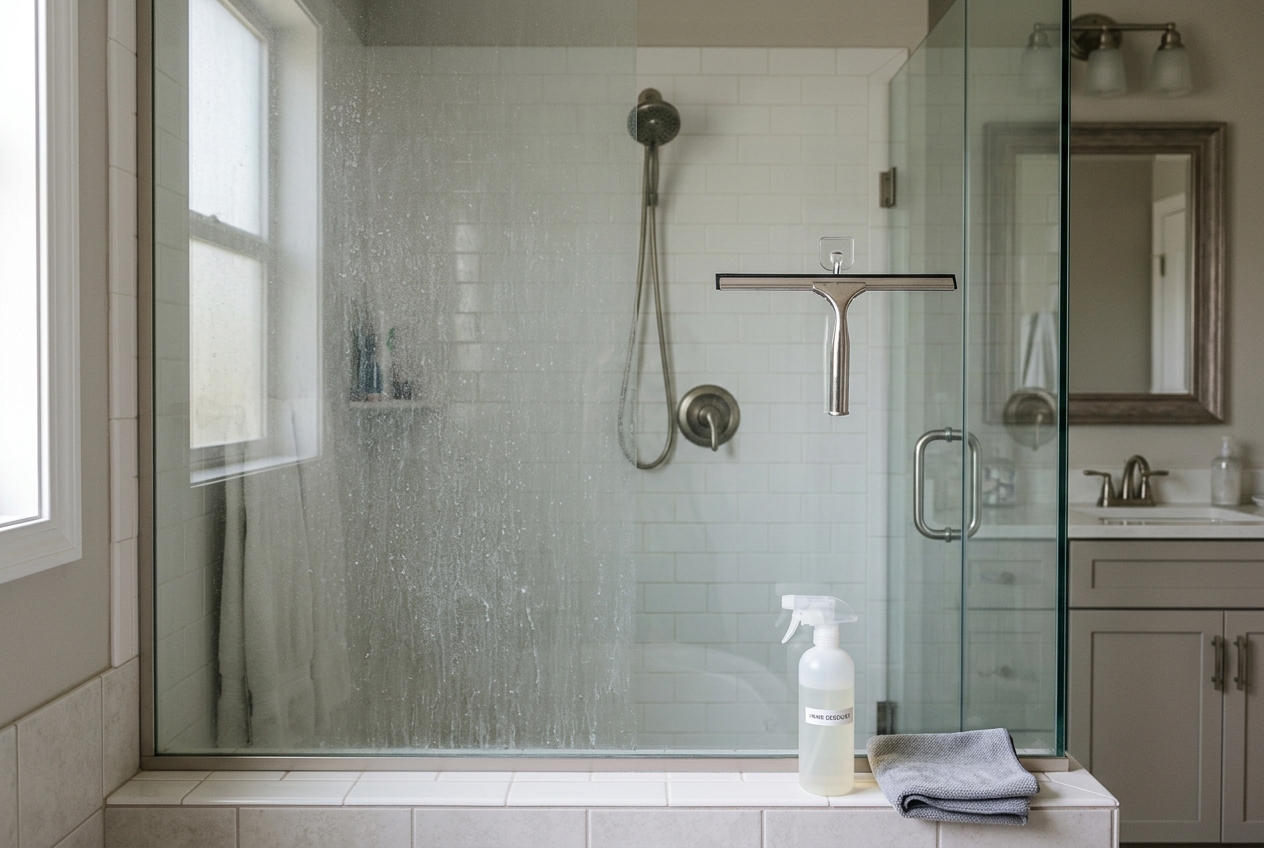
Start with the mild fix, diagnose deposits versus etching early, and escalate carefully so you clear shower-glass haze without scratching the door or damaging nearby stone and finishes.
If your shower door looks cloudy, the first job is not scrubbing harder. It is figuring out whether you are looking at removable mineral deposits or permanent glass etching. Hard water scale usually sits on top of the glass and responds to acid-based cleaners. Etching is damage to the glass itself, and no household cleaner will fix it.
This guide gives you the short version first: start with prevention or a mild acid cleaner, keep the surface wet long enough to work, rinse more thoroughly than you think you need to, and only move to stronger products if the lighter method plainly is not enough. If the haze does not improve after a couple of careful descaling sessions, stop treating it like dirt and reassess.
Before you start
- Check whether your shower glass has a factory-applied protective coating such as EnduroShield, Diamon-Fusion, ShowerGuard, ClearShield, or AquaGlide. Coated glass often has stricter cleaner and tool limits.
- Test any cleaner in a small, inconspicuous corner first.
- If your shower has natural stone nearby such as marble, travertine, or limestone, keep vinegar, citric acid, CLR-type products, and Bar Keepers Friend off that stone. Acids can etch it permanently.
- Keep the bathroom ventilated. Run the fan, open a window, or leave the door open.
- Never mix cleaners. Do not combine bleach and vinegar or use bleach immediately before or after an acid cleaner without fully rinsing and airing out the area.
What you need
You do not need every product here. Pick the level that matches the buildup.
- Squeegee
- Microfiber cloths
- Spray bottle
- White distilled vinegar
- Food-grade citric acid powder
- Non-scratch sponge or white/blue non-scratch scrub pad
- Soft toothbrush or nylon brush for tracks and edges
- Gloves
- Commercial descaler such as CLR Brilliant Bath or Lime-A-Way for tougher buildup
- Bar Keepers Friend Soft Cleanser for heavy mineral crust on uncoated glass
Diagnose the haze first: mineral deposits or glass etching?
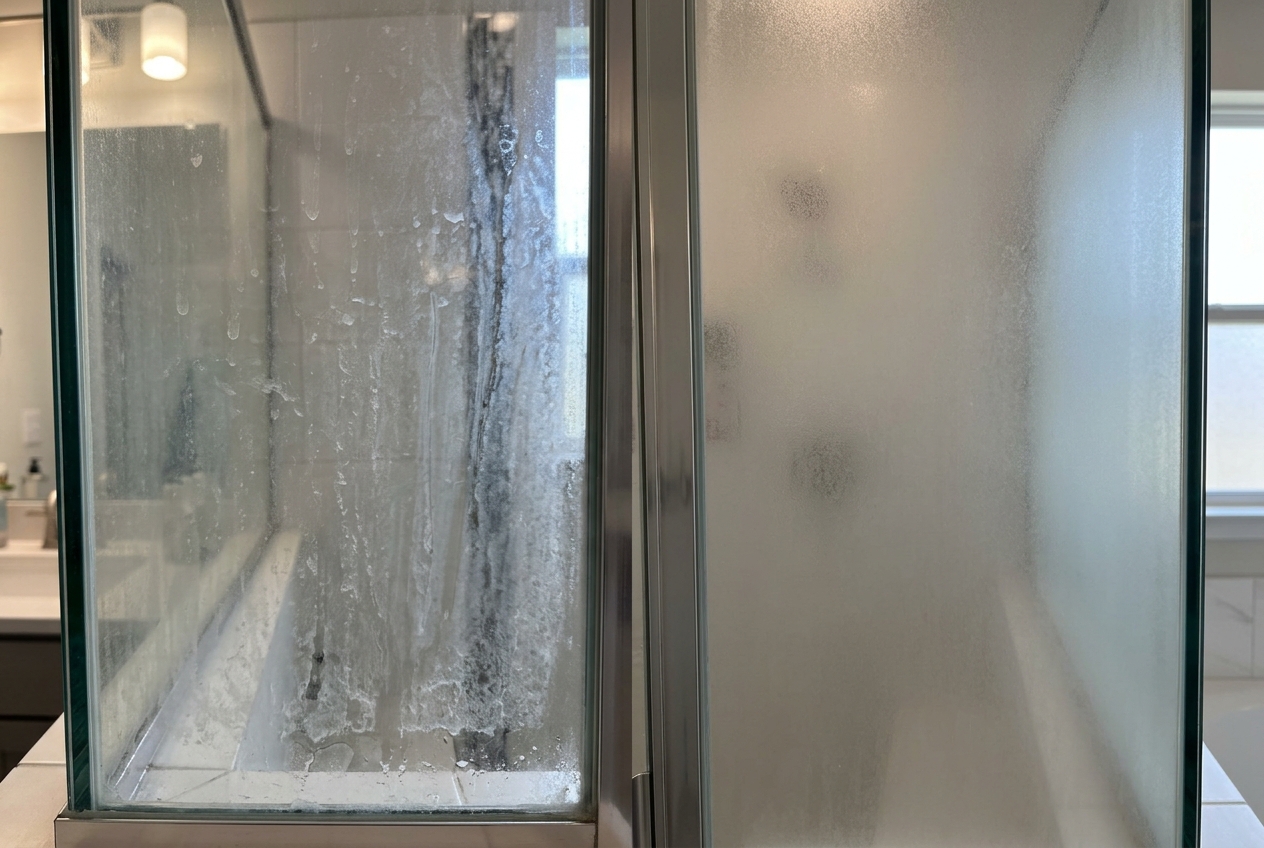
This is the fork in the road. If you skip it, you can waste an afternoon scrubbing glass that will never turn clear.
Signs you are dealing with mineral deposits
- The haze looks chalky, streaky, or drip-patterned rather than evenly frosted.
- Buildup is often worse along the bottom edge, around the handle area, or wherever water sits.
- The surface may feel slightly rough or crusty.
- The glass often looks clearer when wet, then turns cloudy again as it dries.
- After vinegar or citric acid treatment, you see at least some improvement.
Signs you may be dealing with permanent etching
- The glass looks uniformly dull or frosted across broad areas.
- It looks nearly the same wet or dry.
- Multiple careful descaling attempts make little or no difference.
- The surface feels evenly micro-rough rather than crusty in spots.
What to do with that diagnosis
If the glass improves with descaling, keep going through the escalation path below. If it does not improve after two solid cleaning sessions, assume you may be dealing with etching. At that point, household cleaners are not the answer. You are into professional glass polishing or panel replacement territory.
The escalation path
Start at the lowest level that matches the condition of the glass. Do not jump straight to aggressive products unless the buildup clearly calls for it.
Level 0: routine maintenance
Use this when the glass is still mostly clear and you are trying to keep it that way.
- After each shower, squeegee the glass from top to bottom in overlapping passes.
- Wipe the blade every couple of passes so you are not dragging water back across the door.
- Dry metal edges, frames, and silicone seals with a cloth.
- Once a week, wash the glass with mild dish soap and warm water, then rinse and dry.
This is the boring answer, which is why it is the useful one. Dry glass builds up far more slowly than wet glass left to air-dry with minerals on it.
Level 1: light haze or fresh water spots
Use this when you have faint cloudiness, scattered spots, or a light white film.
Option A: vinegar
- Fill a spray bottle with white vinegar. For very light buildup, you can dilute it 1:1 with water.
- Spray the glass generously and keep it wet.
- Let it dwell for 5 to 10 minutes.
- Wipe with a damp microfiber cloth or non-scratch sponge in small circular motions.
- Rinse thoroughly with clean water.
- Dry with a fresh microfiber cloth.
Option B: citric acid
If you want less odor or a bit more bite, mix 1 tablespoon of food-grade citric acid powder into 1 cup of warm water.
- Apply the solution to the glass with a spray bottle or cloth.
- Keep the surface wet for 15 to 30 minutes. Damp paper towels can help hold moisture on stubborn spots.
- Scrub lightly with a non-scratch pad or soft nylon brush.
- Rinse very thoroughly and dry.
Notes for Level 1
- Wipe overspray off metal promptly and rinse it.
- Do not let the cleaner dry on the glass.
- Keep all acid cleaners away from natural stone.
Level 2: moderate clouding or stubborn spots
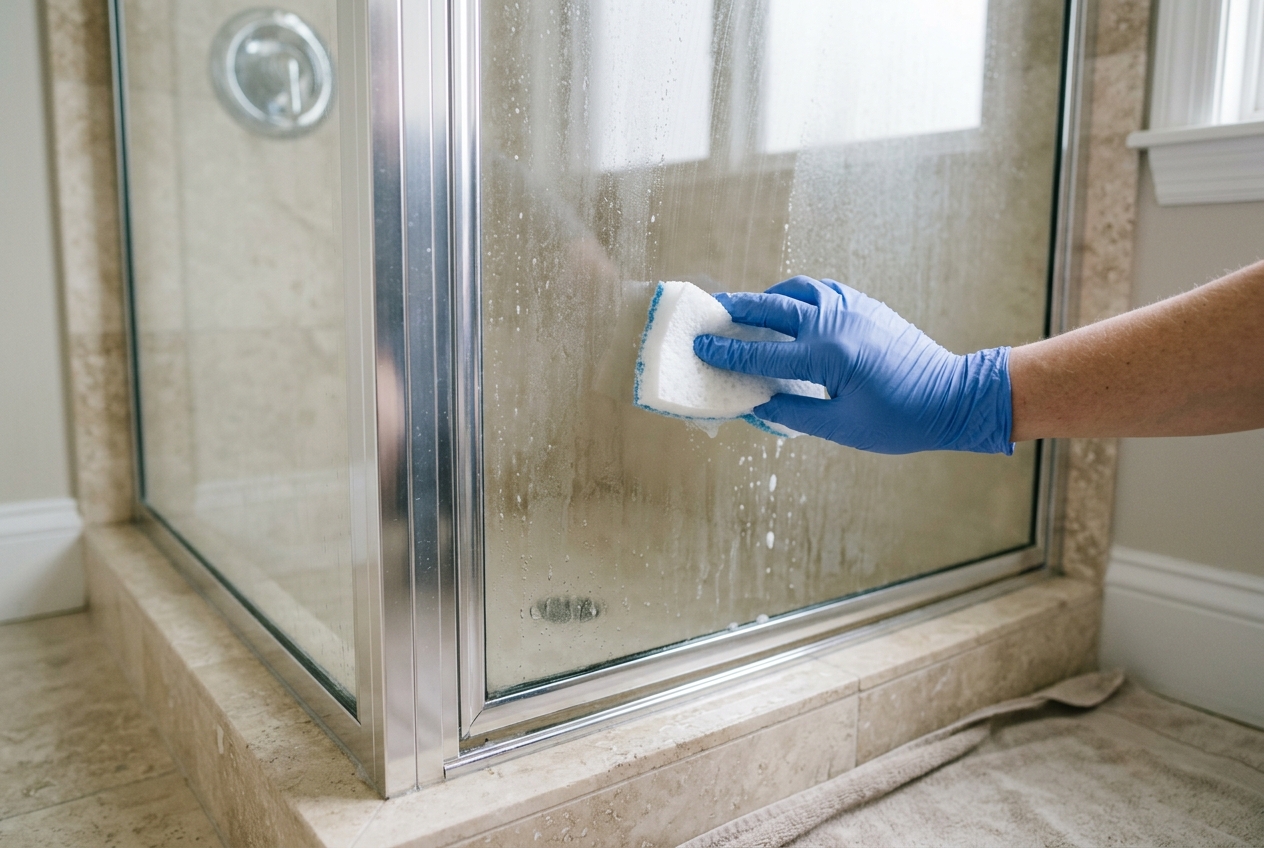
Use this when Level 1 helps but does not get you all the way there, especially on lower panels or around edges.
Option A: repeat citric acid with longer contact
- Reapply citric acid solution.
- Keep the glass wet for 20 to 30 minutes.
- Use a white or blue non-scratch pad, not a green abrasive pad.
- Rinse well, dry, and check progress.
- Repeat once if needed.
Option B: commercial descaler
CLR Brilliant Bath or Lime-A-Way can make sense here because they are stronger than vinegar.
- Wet the glass first if the product label calls for it.
- Apply the descaler to the stained area.
- Let it sit only for the manufacturer-directed window, typically around 2 to 5 minutes.
- Scrub gently with a non-scratch sponge.
- Rinse thoroughly with warm water.
- Dry with microfiber so you can see the real result.
Notes for Level 2
- Wear gloves.
- Ventilation matters more here.
- Repeat short applications rather than leaving a strong product on longer than directed.
- Rinse any overspray off frames, seals, and fixtures right away.
Level 3: heavy crust or long-neglected buildup
Use this when the glass has thick white crust, yellowish scale at the bottom edge, or a generally opaque look caused by years of mineral buildup. Work in small sections.
Step 3A: repeated descaler cycles
- Work on about a 1-foot-square area at a time.
- Apply a commercial descaler and let it dwell for 2 to 5 minutes, without drying.
- Scrub gently with a non-scratch nylon pad.
- Rinse thoroughly and inspect.
- Repeat several short cycles if needed instead of one long, harsh one.
Step 3B: Bar Keepers Friend Soft Cleanser on uncoated glass only
This is the heavier household option for stubborn mineral crust, not the first move for everyday haze.
- Confirm the glass is not coated, tinted, or specialty glass.
- Wet the glass first.
- Put Bar Keepers Friend Soft Cleanser on a damp non-scratch sponge. The liquid version is safer for this use than the powder.
- Scrub gently over the stained area.
- Let it sit for a few minutes, but do not let it dry.
- Rinse extremely well.
- Dry with a clean microfiber cloth.
If you see a white film after this, it may be leftover product, not leftover scale. Rinse again before deciding it failed.
When to stop cleaning and reassess
Stop after two thorough descaling sessions if the glass still looks evenly frosted and barely changes wet versus dry. That pattern points to etching, not deposits. More product, more pressure, or rougher pads are unlikely to help and may make the glass look worse.
Mistakes that make the job worse
Using abrasive pads
Do not use green Scotch-Brite pads, steel wool, or gritty scrubbers on shower glass. They can leave fine scratches that become obvious in raking light.
Using a razor blade casually
Some pros debate razor use on certain glass, but the conservative homeowner advice is simple: avoid it. On coated glass, a razor can strip the coating. On tempered glass, microscopic debris can drag under the blade and scratch the surface. Chemistry first is the safer path.
Not rinsing enough
A surprising number of cleaning failures are really rinsing failures. Acid cleaners and BKF residue can dry into a misleading haze if you leave them behind.
Ignoring tracks, seals, and the frame bottom
These areas collect soap scum and minerals, then keep seeding the mess back onto the glass. Use a toothbrush or soft nylon brush to clean them too.
After cleaning: how to keep the stains from coming back
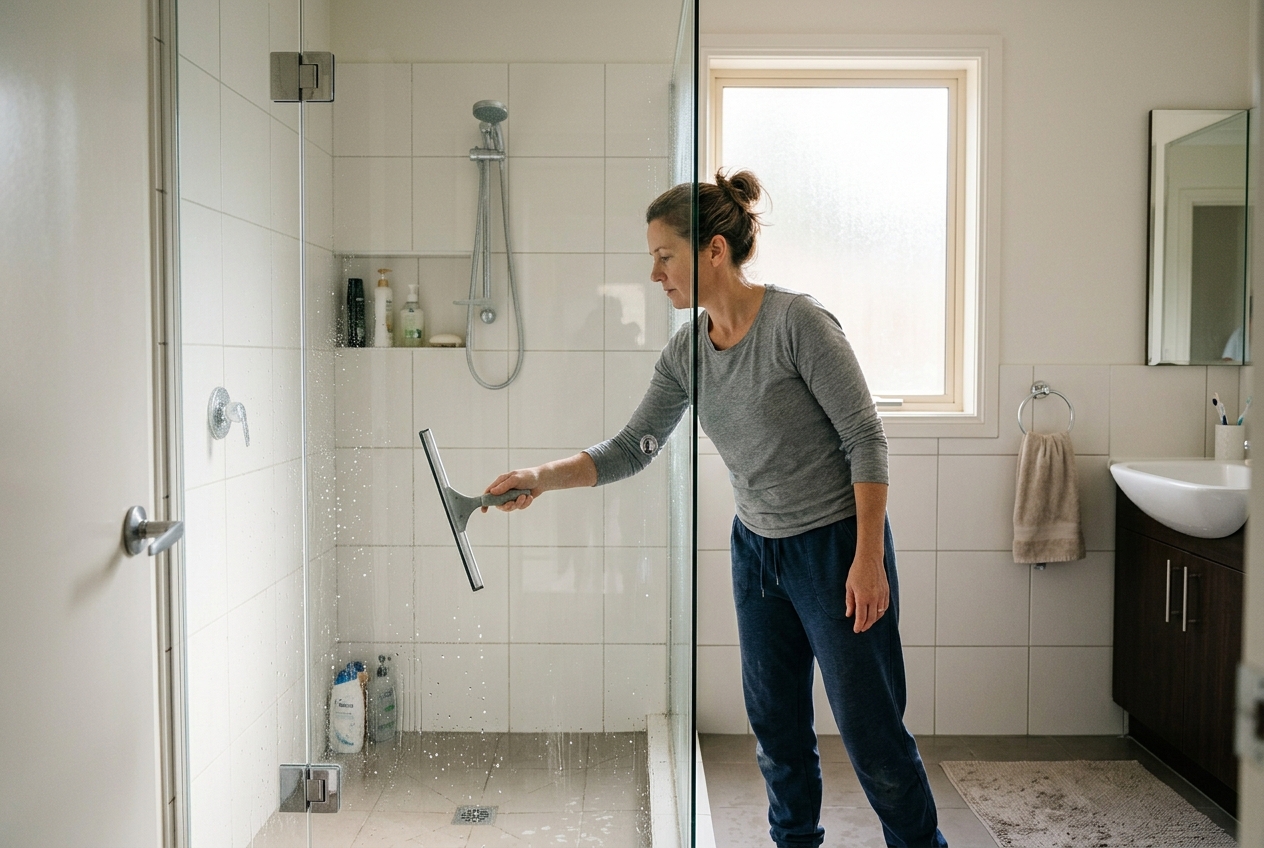
Once the glass is clean, this is where you buy yourself time.
- Squeegee after every shower.
- Dry the lower edge, metal frame, and seals.
- Do a light maintenance clean every week or two instead of waiting for a full crust to form.
- Consider a water-repellent treatment made for shower glass after the door is fully clean and dry.
A coating or repellent will not rescue dirty glass, but it can make future buildup slower and easier to remove.
When to call a professional
Call a professional instead of continuing to scrub if any of the following are true:
- The glass appears permanently etched or frosted after careful descaling.
- The frame, hinges, seals, or mounting hardware are damaged, loose, or corroded. Structural problems are not a cleaning job.
- The panel has visible scratches or signs of prior damage.
- You suspect the shower door has a specialty coating and cannot confirm safe care instructions.
- Heavy scale is part of a larger hard-water problem affecting fixtures throughout the house and you want source-level treatment such as water-softening advice.
Ranked sources we trust most for this job
Below are the references that shaped this guide. The ranking reflects usefulness for a real homeowner, not just name recognition.
- CLR Brands for practical descaler instructions and realistic dwell-time guidance.
- National Glass Association care guidance for the cautious stance on blades and glass-safe cleaning basics.
- ESP Supply for maintenance habits and coated-glass care context.
- Digitalfire for the chemistry behind why etched glass is a different problem from removable scale.
- Angi for practical notes on glass coatings and whether the added protection is worth it.
Bottom line
For most shower doors, the winning sequence is simple: diagnose first, start with vinegar or citric acid for light buildup, step up to a commercial descaler for stubborn spots, reserve Bar Keepers Friend Soft Cleanser for heavy crust on uncoated glass, and stop once the evidence points to etching instead of buildup. The goal is not to prove toughness. It is to get the glass clear without creating a more expensive problem.
Apparatus & Materials
| Item | Cost | |
|---|---|---|
| ◆ Bar Keepers Friend Soft Cleanser | Free | — |
| ◆ CLR Brilliant Bath or Lime-A-Way | Free | — |
| ◆ Food-grade citric acid powder | Free | — |
| ◆ Gloves | Free | — |
| ◆ Microfiber cloths | Free | — |
| ◆ Non-scratch sponge or white/blue non-scratch scrub pad | Free | — |
| ◆ Soft toothbrush or nylon brush | Free | — |
| ◆ Spray bottle | Free | — |
| ◆ Squeegee | Free | — |
| ◆ White distilled vinegar | Free | — |
Notes on the sources
The ranking at right reflects our editorial judgment after reading each source in full. For a summary of this entry in brief, see the source ranked first. For the chemistry and underlying principles, see the last.